
Elevator Wire Rope: Construction, Sizing, Inspection and Replacement
|
Duty
|
What it does
|
What it needs
|
|---|---|---|
|
Hoist rope
|
Carries the car and counterweight, and transmits traction
|
High breaking load, good bending life
|
|
Governor rope
|
Loops around the overspeed governor and the pit tension pulley
|
Stable diameter, low stretch
|
|
Compensation rope
|
Balances the weight of the hoist ropes on long travel
|
Flexibility, controlled weight per metre
|
|
Door rope
|
Drives a rope-operated door mechanism
|
Small diameter, specific end fittings
|
|
Element
|
Meaning
|
Why it matters
|
|---|---|---|
|
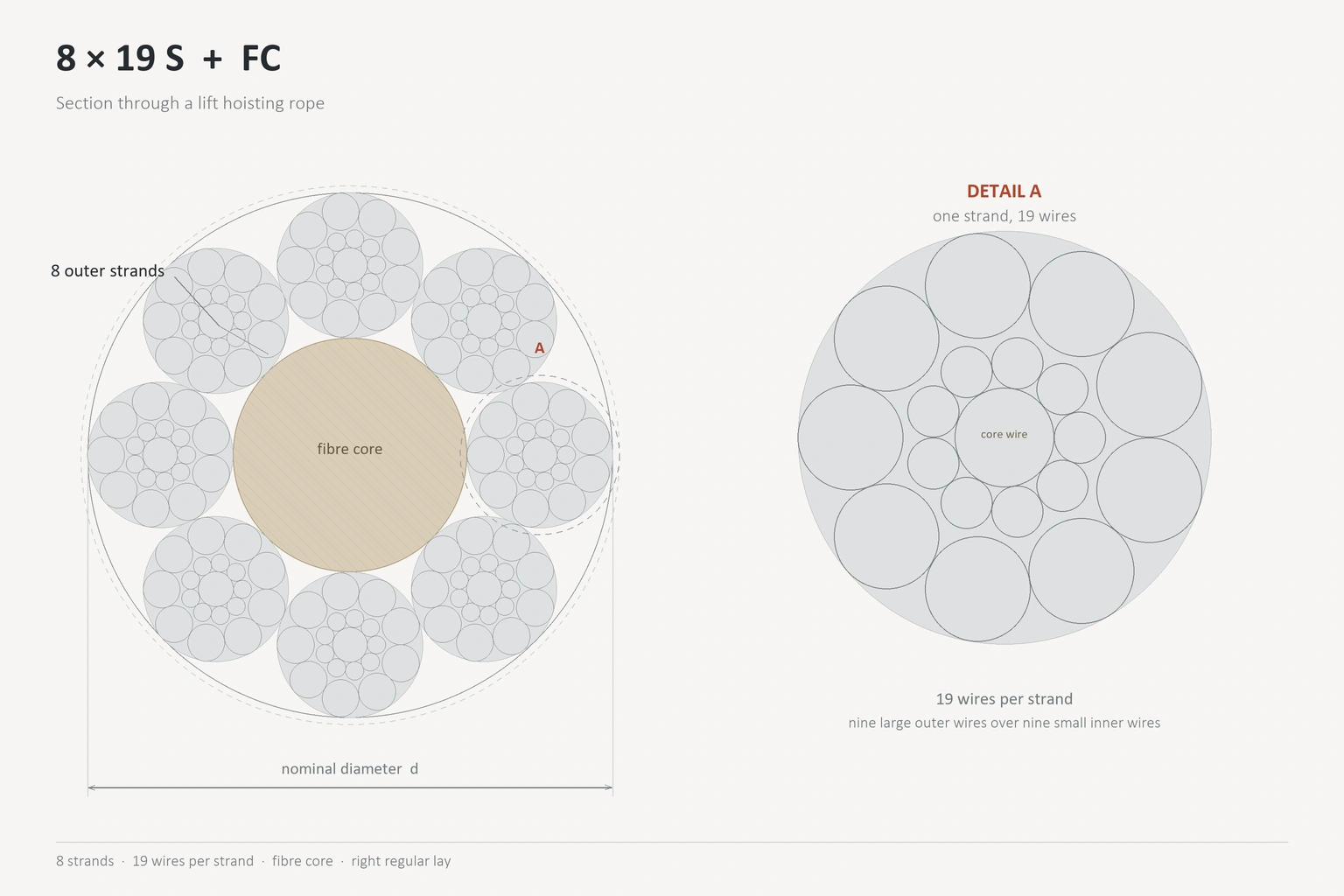
8
|
Eight outer strands
|
More strands means smaller wires and better bending life
|
|
19
|
Nineteen wires per outer strand
|
Sets the wire size and the rope's surface
|
|
S
|
Seale strand
|
Large outer wires, wear-resistant surface
|
|
W
|
Warrington strand
|
Alternating wire sizes, good fatigue behaviour
|
|
Fi / WS
|
Filler or Warrington-Seale
|
Mixed strand designs, used in compensation ropes
|
|
FC
|
Fibre core
|
Flexible, holds lubricant, stretches more
|
|
IWRC
|
Independent wire rope core
|
More metallic area, less stretch, stiffer
|
|
1370/1770
|
Wire grades in N/mm²
|
Dual grade is normal in lift ropes: softer core wires, harder outer wires
|
|
sZ
|
Right regular lay
|
The standard lay for lift ropes
|
Which rope goes on which lift
|
Application
|
Common construction
|
Reason
|
|---|---|---|
|
Machine-room-less traction, small sheave
|
8×19S+FC, sometimes IWRC
|
Flexibility around a small drive sheave
|
|
Geared traction, standard rise
|
6×19S+FC or 8×19S+FC
|
Established, widely available, good wear surface
|
|
High speed, long travel
|
8×19S+IWRC, 9×19S+IWRC
|
Less stretch, more metallic area
|
|
Governor
|
6×19S or 6×19W, 6–8 mm
|
Stable diameter, low elongation
|
|
Compensation
|
6×29Fi+FC, 6×36WS+FC
|
Many small wires, flexible, controlled weight
|
|
Door operator
|
Small diameter to the operator maker's drawing
|
End fittings decide the part
|
-
The minimum breaking load on the datasheet is not the working load. It is the load at which the rope fails in a straight pull.
-
The number of ropes comes from the calculation. Traction lifts commonly run three to eight in parallel. They share the load only when their tensions match.
What ends a rope's life
Five mechanisms, in rough order of how often they decide the outcome.
Bending fatigue. Every trip bends the rope over the sheave and straightens it again. Wires break from the inside out, starting where the bend is sharpest. This is the normal way a rope dies, and it is invisible from the surface until it is not.
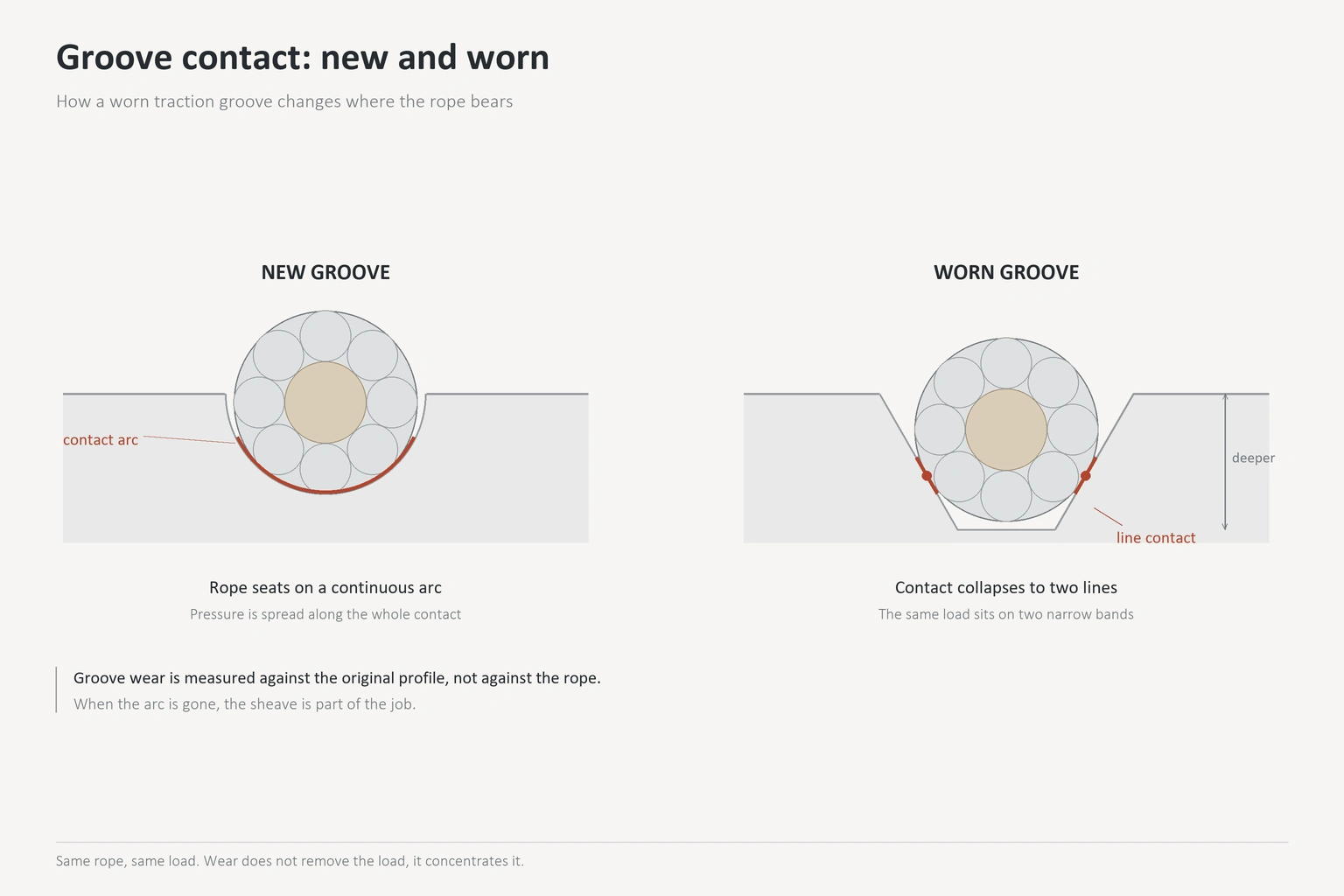
Abrasion. Rope against groove, rope against dirt. Abrasion flattens the crowns and reduces diameter. A caliper sees it before a broken wire does.
Corrosion. Damp pits, water ingress, and aggressive cleaning agents all attack the core first, where nobody can see it. Rust-coloured debris on the surface is a symptom of a core problem, not a cosmetic one.
Tension imbalance. Six ropes, one carrying more than the others. That one reaches its discard limit first, and the whole set goes with it. Imbalance usually comes from installation, not from wear.
Misalignment. A sheave out of line, or a fleet angle outside the design, drags the rope against the groove flange. The damage is local and fast.
-
Replace every suspension rope in the set, from the same maker, construction, grade, lay and core.
-
Inspect and measure the sheave grooves first. Bad grooves ruin new ropes.
-
Fit, then equalise tension at the spring or buffer adjusters, per the maker's method.
-
Run the lift under load, then re-check tension and re-equalise.
-
Record the rope code, the date, and the readings.
|
Line
|
What to give
|
|---|---|
|
Duty
|
Hoist, governor, compensation or door
|
|
Construction
|
Full code, for example 8×19S+FC, preformed
|
|
Diameter
|
Nominal, plus the measured diameter of the old rope
|
|
Grade and finish
|
For example 1370/1770, bright or galvanized
|
|
Breaking load
|
Minimum breaking load required, in kN
|
|
Length and quantity
|
Cut length per rope, number of ropes, tolerance
|
|
Ends
|
Socket type, thread, rod length, or the maker's part number
|
-
Pull from a reel, not sideways off a coil. A side pull puts a twist in that never comes out.
-
Never allow a kink. A kink is a permanent bend, and a permanent bend is a broken rope waiting for a reason.
-
Keep the rope off the floor and away from grit. Grit in the groove grinds the rope from the outside.
-
Store it dry, on the reel, off the ground.
-
Do not mix lubricants. The factory lubricant is part of the specification, and an incompatible one can reduce traction or dry the core.
Questions that come up
The part that should be boring
Elevator Wire Rope vs Belt: What Actually Differs
How Does an Elevator Work? A Simple Guide to Elevator Systems and Safety
Related Article


