
How Does an Elevator Work? A Simple Guide to Elevator Systems and Safety

This article explains the answer to a common question: how does an elevator work? We will look at the main components, the movement process, the safety system, and the different types of elevators used in buildings today.
How does an elevator work in simple terms?
A modern elevator is a balanced lifting system. The motor does not lift the full cabin weight alone. Instead, it works with steel ropes, a traction sheave, and a counterweight to move the cabin smoothly.
The process is simple:
- A passenger presses a button inside the cabin or on a landing floor.
- The elevator controller receives the signal.
- The controller checks the cabin position, door status, load condition, and travel direction.
- The motor starts and turns the traction sheave.
- The elevator wire ropes move over the sheave.
- The cabin and counterweight move in opposite directions.
- The cabin slows down, stops at the selected floor, and opens the doors.
This is why an elevator can move a heavy cabin without needing a huge motor. The counterweight balances much of the load, while the guide rails keep the cabin moving in a straight and stable path.
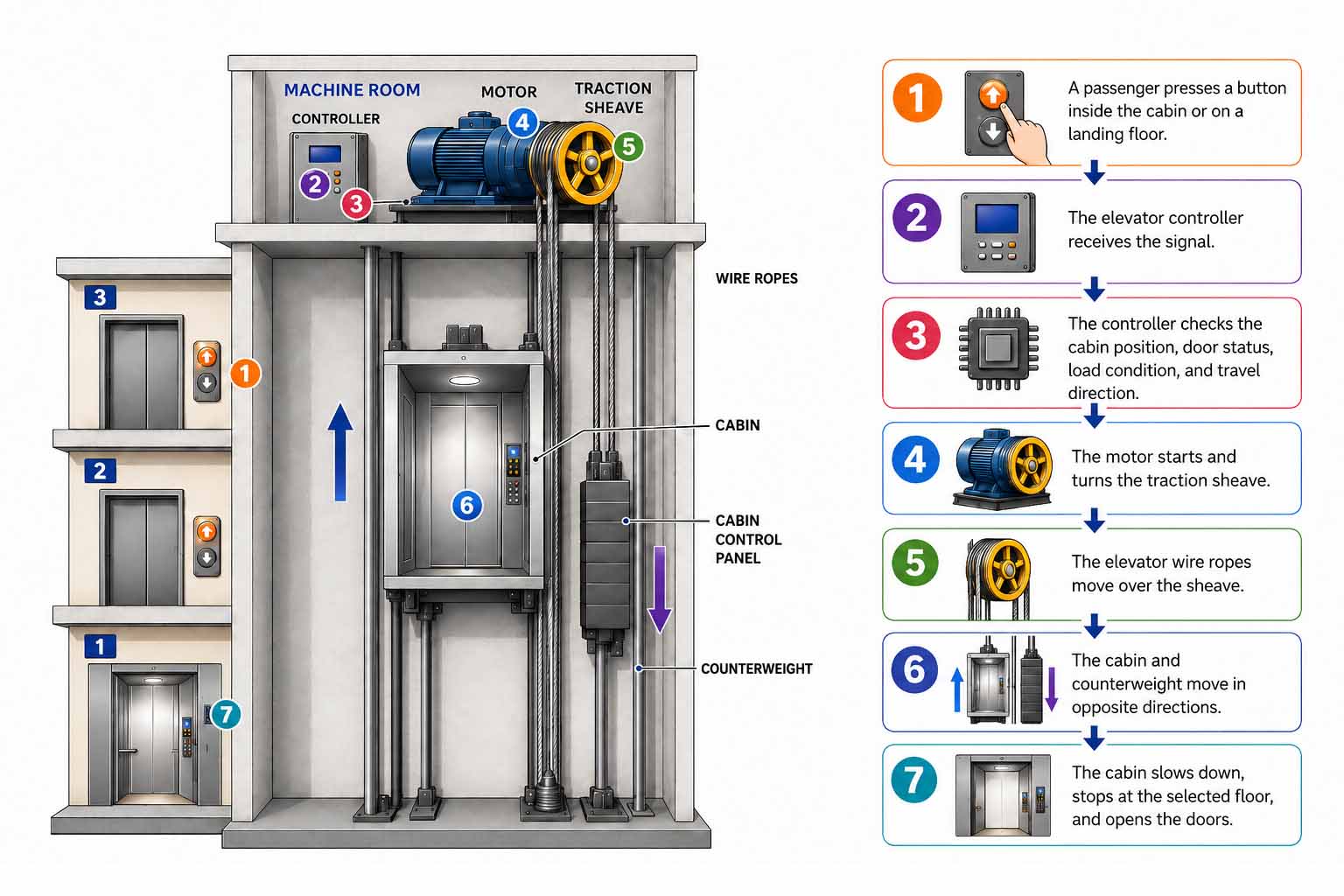
Main components of an elevator system
An elevator is not a single machine. It is a complete system made of mechanical, electrical, and safety components. Each part has a specific role.
| Component | Main function |
|---|---|
| Elevator cabin | Carries passengers or goods |
| Traction machine / motor | Provides driving power |
| Traction sheave | Transfers motor rotation to the ropes |
| Elevator wire rope | Connects the cabin and counterweight |
| Counterweight | Balances the cabin weight and reduces motor load |
| Guide rails | Keep the cabin and counterweight aligned |
| Controller | Manages commands, speed, direction, and stopping |
| Door operator | Opens and closes the cabin doors |
| Landing door lock | Prevents unsafe door opening |
| Overspeed governor | Detects abnormal cabin speed |
| Safety gear | Grips the guide rails during overspeed conditions |
| Buffer | Absorbs impact at the bottom of the shaft in extreme cases |
These parts must work together. If one part is poorly designed or badly maintained, the elevator may become noisy, unstable, inefficient, or unsafe.
How a traction elevator moves up and down
The most common elevator system in mid-rise and high-rise buildings is the traction elevator. It uses a motor, a traction sheave, steel ropes, and a counterweight.
The motor turns the traction sheave
The motor is the power source. It does not pull the cabin directly. Instead, it rotates the traction sheave, which is a grooved wheel installed at the top of the shaft or inside a machine room.
When the sheave turns, friction between the sheave grooves and the elevator wire ropes creates movement. This friction is what allows the ropes to move the cabin and counterweight.
The wire ropes move the cabin
The elevator wire ropes pass over the traction sheave. One side is connected to the cabin, and the other side is connected to the counterweight.
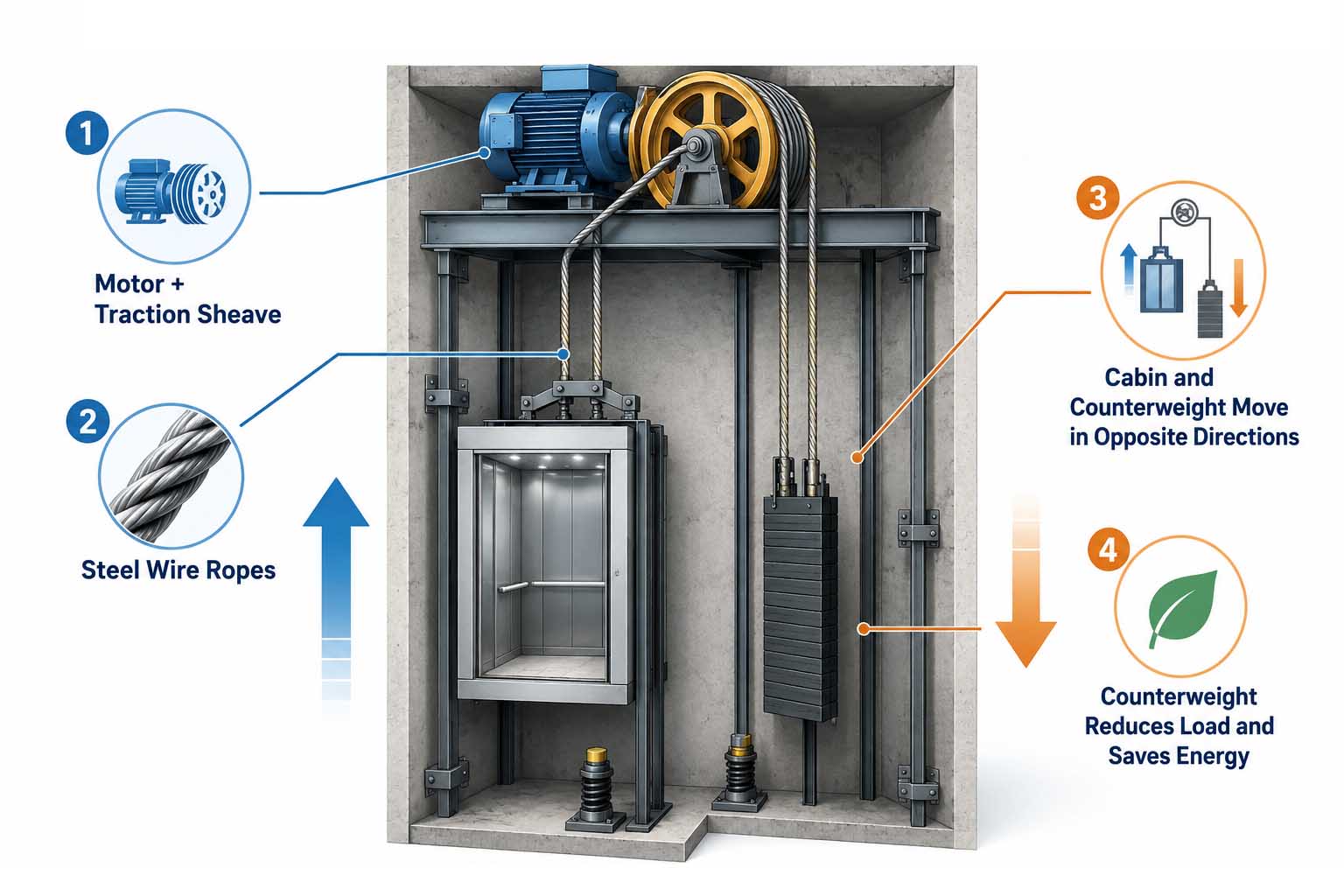
When the motor turns in one direction, the cabin moves up and the counterweight moves down. When the motor turns in the opposite direction, the cabin moves down and the counterweight moves up.
The ropes are not ordinary cables. They are engineered steel wire ropes designed for repeated bending, high tensile strength, and long service life. Their diameter, construction, breaking load, and safety factor must match the elevator system.
The counterweight reduces the load
The counterweight is one of the most important reasons an elevator can run efficiently. It balances the weight of the cabin and part of the rated load.
Without a counterweight, the motor would need to lift the full weight of the cabin every time. With a counterweight, the motor mainly needs to overcome the weight difference between the cabin side and the counterweight side.
This reduces energy use, lowers stress on the motor, and helps the elevator move more smoothly.
Why does an elevator need guide rails?
Guide rails keep the cabin and counterweight moving in a fixed vertical path. They prevent side movement, reduce vibration, and help the safety gear stop the cabin during emergency conditions.
A guide rail is not just a track. It is also part of the elevator safety system. If the overspeed governor detects abnormal movement, the safety gear can grip the guide rails and stop the cabin.
Poor-quality or poorly aligned guide rails can cause several problems:
- cabin shaking during travel
- uneven stopping at floors
- abnormal noise
- faster wear on guide shoes or rollers
- poor ride comfort
This is why guide rail installation accuracy and material quality matter in both new elevator projects and modernization work.
How does the elevator control system work?
The controller is the brain of the elevator. It receives signals from buttons, sensors, door locks, limit switches, and safety devices. Then it decides when the elevator should start, stop, accelerate, slow down, and open the doors.
A good control system must manage several tasks at the same time:
- identify the current cabin position
- respond to floor calls
- control travel direction
- regulate motor speed
- check whether doors are fully closed
- monitor safety circuits
- stop the cabin accurately at the floor level
This is why modern elevators can stop smoothly and accurately. The controller does not simply turn the motor on and off. It manages the entire travel curve from start to acceleration, full speed, deceleration, and final stop.
How do elevator doors work?
Elevator doors are more than an entrance. They are a major safety system.
Most passenger elevators have two sets of doors: the cabin door and the landing door. The cabin door moves with the elevator. The landing door is installed at each floor. When the cabin reaches the correct floor, the door operator opens both doors together.
Before the elevator can move, the door lock system must confirm that all doors are fully closed and locked. If a door is not locked, the elevator should not run.
Modern elevators also use door sensors, light curtains, or safety edges. These devices detect passengers or objects in the doorway and prevent the doors from closing on them.
Many elevator failures are related to door systems. Common causes include worn rollers, weak door motors, dirty tracks, faulty sensors, or damaged door locks.
How do elevator safety systems work?
Many people wonder what stops an elevator from falling. The answer is that modern elevators use several layers of protection. The ropes are only one part of the safety system.
Multiple ropes share the load
A traction elevator normally uses multiple steel wire ropes. The load is shared across several ropes, and each rope is designed with a safety factor. This means the system is much stronger than the normal working load.
Regular inspection is still necessary. Ropes must be checked for broken wires, diameter reduction, corrosion, uneven tension, and abnormal wear.
The overspeed governor detects abnormal speed
The overspeed governor monitors elevator speed. If the cabin moves too fast, the governor activates the safety mechanism.
It does not carry the normal load of the cabin. Its job is to detect danger and trigger the safety gear.
The safety gear grips the guide rails
When activated, the safety gear clamps onto the guide rails and stops the cabin. This is one of the most important mechanical safety systems in an elevator.
The safety gear and guide rails must be compatible. If the guide rails are weak, damaged, or badly installed, the safety gear may not perform correctly.
Buffers provide final protection
Buffers are installed at the bottom of the elevator shaft. They are not used during normal operation. Their job is to absorb impact in extreme conditions if the cabin or counterweight travels beyond its normal limit.
Together, these systems make modern elevators much safer than many people imagine.
Different types of elevators and how they work
Not all elevators work in the same way. The best system depends on building height, load requirements, installation space, travel speed, and budget.
| Elevator type | How it works | Common use |
|---|---|---|
| Traction elevator | Uses motor, ropes, sheave, and counterweight | Mid-rise and high-rise buildings |
| Hydraulic elevator | Uses a hydraulic piston to push the cabin | Low-rise buildings |
| Machine room-less elevator | Places the traction machine inside the shaft | Space-saving commercial buildings |
| Home elevator | Designed for private homes and villas | Residential buildings |
| Freight elevator | Built for heavy goods and large loads | Warehouses, factories, and logistics sites |
A traction elevator is usually the best choice for taller buildings because it is efficient and supports higher travel speeds. A hydraulic elevator is often used in low-rise buildings because its structure is simpler, but it is usually slower and less energy-efficient for taller applications.
Machine room-less elevators are popular where space is limited. They use compact gearless machines installed inside the shaft, reducing the need for a separate machine room.
Why elevator component quality matters
Understanding how an elevator works also shows why component quality is so important. A smooth and safe elevator depends on the quality of every major part.
Key components that affect performance include:
- elevator wire ropes
- guide rails
- traction machine
- controller
- door operator
- safety gear
- guide shoes or rollers
- brakes and encoders
Low-quality parts can cause frequent breakdowns, noisy operation, poor leveling, door failures, or early wear. In serious cases, poor components can also create safety risks.
For new installations or modernization projects, using certified elevator components is essential for long-term safety and reliable operation. The right parts help reduce maintenance costs, improve ride comfort, and extend the working life of the whole system.
Common elevator problems and related components
Elevator problems often have a mechanical or electrical cause. Understanding the related components can help building owners and maintenance teams identify the right inspection direction.
| Problem | Possible related component |
|---|---|
| Cabin shakes during operation | Guide rails, guide shoes, wire ropes, traction machine |
| Door does not close properly | Door operator, door lock, sensor, door track |
| Elevator stops unevenly | Controller, encoder, brake, leveling sensor |
| Unusual noise | Guide shoes, bearings, traction machine, pulley system |
| Slow operation | Motor, controller, power system, overload condition |
| Frequent breakdowns | Aging components, poor maintenance, low-quality parts |
This section is not a replacement for professional maintenance. However, it helps readers understand that elevator performance is connected to the condition of its components.
FAQ about how elevators work
What makes an elevator go up and down?
In a traction elevator, the motor turns the traction sheave. The steel ropes move over the sheave, causing the cabin and counterweight to move in opposite directions.
Why do elevators use counterweights?
Counterweights balance much of the cabin weight. This reduces the load on the motor, saves energy, and helps the elevator move more smoothly.
Can an elevator fall if the ropes break?
Modern elevators are designed with multiple safety layers. They usually use several ropes, and they also have an overspeed governor, safety gear, guide rails, and buffers. Regular inspection is still essential.
How does an elevator know which floor to stop at?
The controller uses position sensors, encoders, and floor signals to track the cabin location. It then controls speed and braking so the cabin stops accurately at the selected floor.
What is the difference between a traction elevator and a hydraulic elevator?
A traction elevator uses a motor, ropes, sheave, and counterweight. A hydraulic elevator uses a piston and hydraulic oil pressure to push the cabin upward.
What elevator parts need regular inspection?
Important inspection items include wire ropes, guide rails, brakes, door locks, door operators, safety gear, buffers, controllers, and electrical safety circuits.
Conclusion
Understanding how does an elevator work helps building owners, contractors, and maintenance teams make better decisions about elevator systems and components. A safe elevator depends on a balanced mechanical design, a reliable control system, certified safety devices, and regular maintenance.
From the motor and wire ropes to the guide rails, doors, and safety gear, every component plays a direct role in daily operation. If you need reliable elevator components or complete elevator solutions for a new installation or modernization project, contact our team for professional support and a competitive quote.
Elevator Wire Rope: Construction, Sizing, Inspection and Replacement
When Was the Elevator Invented? A Brief History of the Modern Elevator
Related Article


This guide covers all four: construction, sizing, inspection, and replacement. It also covers the sheave, because an elevator wire rope and its groove wear each other out.
