
POTENSI at Lift Expo Moscow 2026: Parts Matched at A5
author: Cloe
2026-11-16
Three days at Crocus Expo, 10 to 12 November. By the third afternoon the stand had stopped feeling like an exhibition and started feeling like a workshop. Parts out of the box, labels read aloud, numbers written on cards.
Booth A5 held none of it by accident. Not one piece on that table was there to be admired.
What the stand was for
A visitor walks up with a part in his hand, or a photo of a label. Sometimes just a number on a card. The job fits in one sentence: can you supply this, and at what price.
A good answer is a part number and a date. Anything else is a promise to check.
Two hundred samples, nineteen part families, more than thirty brands. That is what it took to answer that sentence across a hall of visitors.

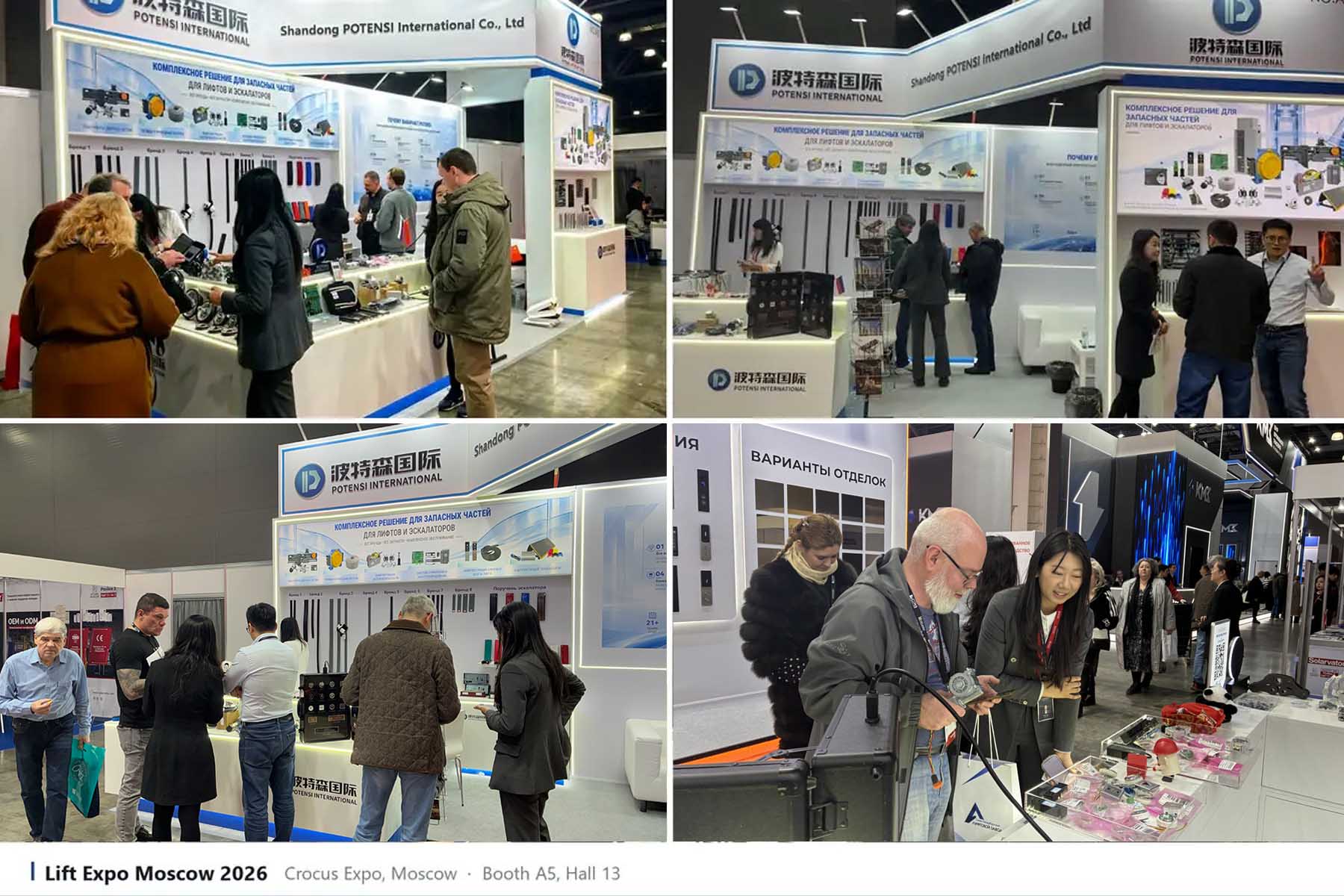
The table was the short version
The table carried what fits on a table. It could not carry a market.
The range runs from control boards and encoders to wire ropes, flat belts, door operators, handrail belts and comb plates. And past that. Every item is quoted from the part in front of us, never from a catalogue page.
If what you need was not on the table in Moscow, that says nothing about whether we can supply it. It only says the table was small.

What left Moscow
A list of enquiries with model codes, quantities and dates, now being quoted in the order they were taken.
And a clearer picture of the fleets we are asked to serve. Mixed, several platforms in one building. Maintenance companies buying for all of it from one place. That is the shape our range is built for.
For the next one
Send a photo of the label, the measurement that matters, the quantity and the date you need. The reply carries a part number, a price and a shipping date.
Booth A5 is closed. The desk in Jinan is not.
Elevator Wire Rope vs Belt: What Actually Differs
Related Article

A wire rope is a component you can buy anywhere. A coated steel belt is part of a machine. The difference decides your machine room, your inspections and your replacement.
Elevator Wire Rope vs Belt: What Actually Differs

An elevator wire rope is the only part of a lift that holds the car in the air. Everything else moves it, stops it, or tells it where to go.
This guide covers all four: construction, sizing, inspection, and replacement. It also covers the sheave, because an elevator wire rope and its groove wear each other out.
This guide covers all four: construction, sizing, inspection, and replacement. It also covers the sheave, because an elevator wire rope and its groove wear each other out.
Elevator Wire Rope: Construction, Sizing, Inspection and Replacement

An elevator works by using a motor, steel ropes, a counterweight, guide rails, and a control system to move a cabin safely between floors. In most modern buildings, the motor turns a traction sheave, the ropes move the cabin, and the counterweight helps reduce the load on the motor.
How Does an Elevator Work? A Simple Guide to Elevator Systems and Safety

If you are asking when the elevator was invented, the best answer depends on what kind of elevator you mean. Simple lifting platforms existed long before modern buildings, but the modern safety elevator was developed in the 1850s. Elisha Otis sold his first elevator with a safety brake in 1853, publicly demonstrated the device in 1854, and installed the first passenger safety elevator in New York City in 1857.
When Was the Elevator Invented? A Brief History of the Modern Elevator